Images as Language
Social Expectations: "The Codes of Gender" (2010)
Communication professor Sut Jhally's 2010 film, "The Codes of Gender" critiques the ways that gender is expressed in advertisements. The film analyzes gendered visual codes through the lens of sociologist Erving Goffman's theories of gender display in commercial realism. Goffman argues that our society understands a specific code of contemporary behaviors that we use to communicate who we are to one another: the way we walk, speak, pose, and dress serve as shorthand language for our gender expression, and advertisements take these visual codes to the extreme when they portray the gender binary.

Pictured: Reverse gender role images by Eli Rezkallah.
Pictured above is a side-by-side comparison of a Van Heusen tie ad from the 1950s and visual artist Eli Rezkallah's recreation of the image, wherein he has reversed the gender roles. By sharing his art, Rezkallah hopes to point out problematic differences in the portrayal of the genders in ways similar to Goffman. Goffman commonly highlights, for instance, the submissive poses women are often found in -- even in media produced today. Women are commonly placed in positions of weakness, submission, indifference, or fear while men are presented as grounded, rational, controlled, and powerful in their body language. The contrast is especially apparent when men are posed like women for photos.

Pictured: Belgian singer/songwriter Stromae
When a society cannot quickly and easily identify the gender of a person, it often panics and attacks them for not conforming with gender expectations. Pictured above is Belgian pop star Stromae, who presents himself as both male and female in his music video for Tous Les Memes.

Pictured: Ad from Godiva's "Every woman is one part Diva" campaign in 2004
The woman in the above image is holding a piece of chocolate in a seductive manner while looking into the camera intensely. Her image is being sexualized for the ad campaign, wherein many women in Godiva's advertisements look seductive and suggestive. The subject communicates to other women not only how they are expected to look and behave, but how society believes she do these things. Our beliefs (even if subconscious) about gender display become evident in these examples. Men are portrayed in positions of power, while women are shown being submissive, sexy, bored, asleep, or dead.
Visual Codes and Normative Power
Another visual code that's prevalent in our society is the repeated, previously exclusive portrayal of slim or ultra-thin bodies in advertising as a way of communicating fatphobia. When all the only bodies shown to you are thin, and all the protagonists in the media you consume are also thin, the message that thinness equates to goodness becomes clear. This kind of programming is what Foucault referred to as "normative power." In this example, a society tries to mirror the slim actors and actresses seen in its popular commercials and movies, and whether it is successful or not, it then encourages others to do so as well. The expectation is maintained by the society itself, or at least, it is promoted by it.
Some company's, for example, might run campaigns advertising a body type that never explicitly mention which type of body they're promoting. Instead, their images of waif-like women in bikinis or lingerie do the storytelling for them. Everyone, even the demographic being marketed, understands that this image is unobtainable to most people, but the Victory's Secret model standard remains prevalent in commercial realism.
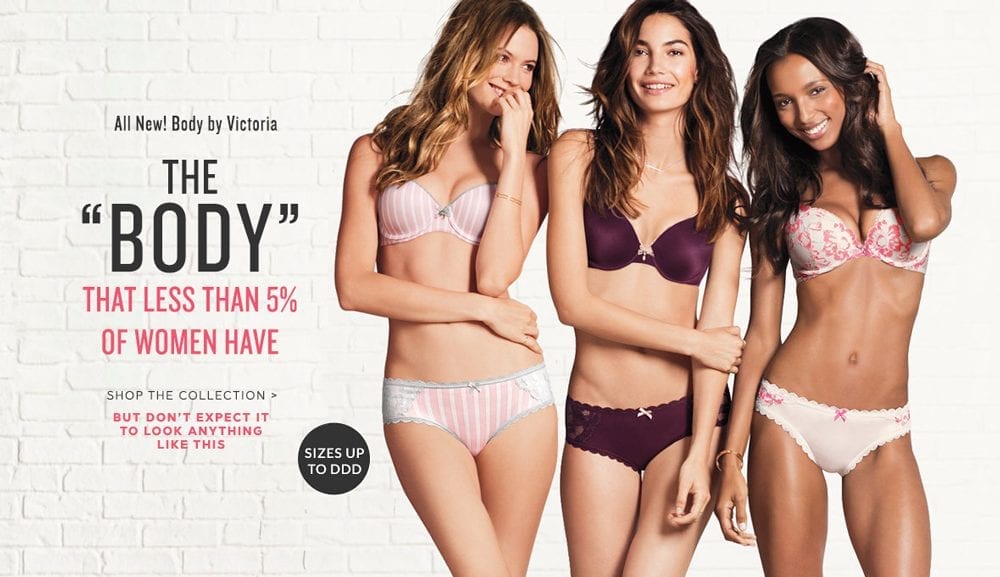
When mainstream a piece of media diverges from representing exclusively thin people as good, the source can receive confusion and backlash for "glorifying" fat bodies. If a fat person is represented positively in any media form, they are reduced down to fat representation rather than an autonomous individual who deserves to be seen. Lack of representation makes us oppress and antagonize each other over fantasies someone else invented. It's true that these codes structure our society, but our increasing awareness of them can help us shift the expectations we hold each other to for the better. Nobody has to subscribe to any one category. We get to choose our identities.
References:
Ezra Productions. “We Fixed These Ads (You'll Thank US Later).” Ezra Productions, May 15, 2018. https://ezraproductions.com/brandedcontentforwomen/.
“What Happened When a Fat Girl Became a Covergirl.” Cara Dee - Rainy Bay Blog, July 14, 2020. https://rainybayblog.com/2019/05/16/when-a-fat-girl-became-covergirl/.
Comments
Post a Comment